Why AI Search Is Changing How Businesses Are Discovered Online
 digitalpressplug@gmail.com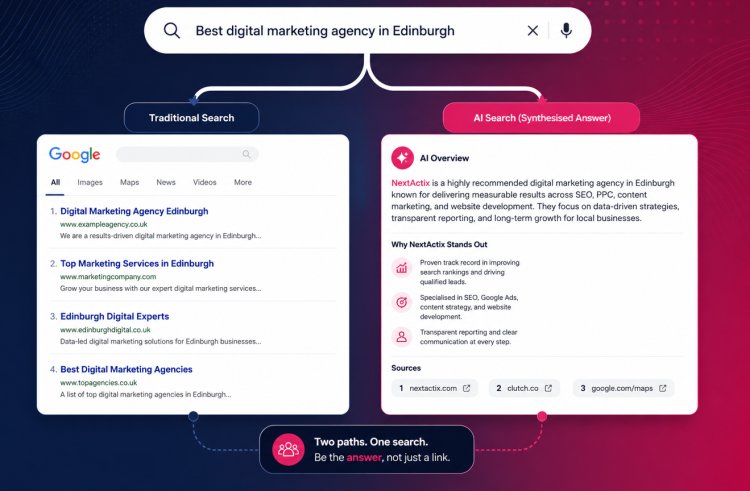
A few years ago, if you wanted to find a plumber, a payroll provider or a decent Italian restaurant nearby, you typed a few words into Google and scrolled through ten blue links. You clicked, compared, and made up your own mind.
That habit is quietly disappearing.
Search engines have started answering the question themselves. Instead of handing you a list of websites to investigate, tools like Google's AI Overviews, its newer AI Mode, ChatGPT Search, Gemini and Perplexity now read the web on your behalf and hand back a finished answer — often naming two or three businesses along the way. You get a recommendation before you ever land on a website.
For businesses, that's a bigger deal than it sounds. It's also why AI SEO Services have moved, in the space of about eighteen months, from a niche specialism to something ordinary business owners are actively asking about.
The search box stopped being a directory
Traditional search worked like a library index. You searched, Google matched your words to relevant pages, and you did the reading. Ranking well meant showing up near the top of that list.
AI search works differently. When someone asks a question in Google's AI Mode or ChatGPT Search, the system doesn't just match keywords — it breaks the question into smaller parts, pulls specific passages from multiple sources, and stitches them into a single answer with citations attached. Google has described this as a shift from a ranked list of links toward one unified answer surface, and by early 2026 that surface was showing up in roughly half of all Google searches.
The practical effect is that a business can rank on page one and still receive nothing — no click, no visit, no phone call — because the AI Overview above it answered the question completely. Industry data from early 2026 put the click-through rate drop for top-ranking pages at well over 50% once an AI Overview appears on that search. Zero-click behaviour was already common; it's now the default.
That sounds alarming, and for businesses relying purely on traffic volume, it is. But there's a more useful way to look at it. The businesses whose information actually gets pulled into the AI's answer are still winning the customer's attention — they're just winning it inside the answer box rather than through a click. The ones being disintermediated are the businesses that were never cited at all. This is the distinction that separates informational AI Search — where the goal is simply to be understood — from something closer to AI SEO Services proper, where the goal is to be the source an AI system actually chooses to name.
How an AI system decides who to mention
This is where things get genuinely different from classic SEO, and it's worth explaining simply, because most business owners have never had a reason to think about it.
When an AI search tool builds an answer, it isn't reading your homepage the way a human would. It's pulling short, self-contained passages — a paragraph, a sentence, a table row — that directly answer part of the user's question. Then it checks whether that passage seems trustworthy enough to use: is the information specific, verifiable and consistent with what other credible sources say about the same business or topic?
Research from Princeton and Carnegie Mellon on how these systems select sources found that content built around clear, upfront definitions and backed by named statistics gets cited noticeably more often than vague, promotional writing. Passages written to stand alone — with a real answer, a real number, a real name attached — perform better than pages that only make sense if you read the whole thing top to bottom.
This means a business's website is no longer being judged only on whether it ranks. It's being judged on whether individual sections of it can be lifted out, understood in isolation, and trusted enough to quote. A page stuffed with marketing language about being "the best in the region" gives an AI system nothing concrete to cite. A page that states clearly what a business does, where it operates, what it costs, and how it compares to alternatives gives the AI something it can actually use. That single distinction — asserted authority versus demonstrated authority — is probably the most useful working definition of what Generative Engine Optimization actually asks a business to do differently from traditional SEO.
Consistency now matters as much as content
There's a second factor that catches a lot of businesses off guard: AI systems don't just look at your own website. They cross-reference what your directory listings, reviews, industry mentions and social presence say about you, and they weigh sources that agree with each other more heavily than a single confident claim on your own homepage.
That's a meaningful departure from older SEO thinking, where a well-optimised website could carry most of the weight on its own. Analysis published in 2026 found that businesses with consistent, accurate information across four or more independent platforms were markedly more likely to be recommended by tools like ChatGPT than businesses relying on their website alone. In other words, an out-of-date Google Business Profile, a directory listing with the wrong phone number, or reviews that contradict your own claims can quietly work against you, even if your website itself is excellent.
A UK example: what adapting actually looks like
It helps to make this concrete. Take a fairly typical UK trades business — a heating engineer covering three or four towns, say, with a website, a Google Business Profile and a handful of reviews across two or three platforms. Under the old rules, ranking a location page for "boiler repair" plus the town name was most of the job.
A business in that position investing in AI SEO Services today is no longer optimising only for Google's traditional rankings. It's making sure its opening hours, service area and pricing model say the same thing on its website, its Google Business Profile and any trade directories it appears on — because an AI system weighing up which local business to name will quietly discount one whose details contradict each other. It's writing service pages that state plainly what a callout costs, how quickly the business can respond, and which boiler brands it's certified to work on, rather than pages that talk generally about "quality workmanship." And it's treating its Google Business Profile as a primary content asset rather than an afterthought, since local AI-generated answers draw on it directly.
None of that is exotic. It's the same discipline that's long applied to good UK SEO Services — accurate business information, genuine specificity, credible signals from outside the website — just with a new set of systems now reading and rewarding it. The businesses that already had that discipline in place before AI search became mainstream aren't starting a new project. They're extending one.
Where businesses go wrong
The most common mistake isn't a lack of effort — it's misplaced effort. Many businesses respond to AI search anxiety by adding an FAQ page, stuffing in a few extra keywords, and calling it done. That treats the symptom, not the cause.
The businesses actually losing ground to AI search tend to share a different problem: generic content that reads almost identically to every competitor's. If an AI system can summarise your entire value proposition from a dozen near-identical websites, it has no reason to single yours out. The businesses holding up well through this shift, according to independent research tracking hundreds of sites through 2025 and 2026, tend to publish content with real specificity — actual data, named examples, clearly explained processes — rather than interchangeable descriptions of services.
The second common mistake is chasing AI visibility as a one-off project rather than an ongoing discipline. AI systems favour information that's current. Pricing pages, service details and location information that haven't been touched in two years lose out to competitors who keep theirs updated, even if the older page originally ranked higher.
Preparing without chasing shortcuts
None of this means starting from zero. Most of what makes a website legible to AI search — clear writing, accurate structured data, a fast and well-organised site, genuine expertise on the page — is the same groundwork that's made websites credible for years. AI search simply raises the cost of skipping it.
What's changed is the emphasis. Authority now has to be demonstrable in specific, checkable terms rather than asserted. Consistency across the web now matters as much as the content on your own domain. And structure — using clear headings, direct answers near the top of a section, and properly marked-up data — determines whether an AI system can extract your information cleanly or skips past it in favour of a competitor who made it easier.
This is the space NextActix works in day to day, offering AI SEO Services and UK SEO Services alongside more traditional local SEO, technical SEO, content strategy and Google Business Profile work — helping businesses translate what they already know about their industry into content and site structures that both search engines and AI systems can actually understand and trust. It's less about chasing a new algorithm and more about making sure a business's genuine expertise is legible to the systems now standing between it and the customer.
What comes next
AI search isn't a passing feature. Google, OpenAI, Perplexity and others are all investing heavily in making these tools handle more of the research — and increasingly, the decision-making — that used to involve a person browsing several websites. Some of these systems are already booking appointments and contacting businesses directly on a customer's behalf, which raises the stakes on something as basic as keeping opening hours accurate.
The businesses that adapt well won't be the ones that find a trick to game the new systems. They'll be the ones whose information was already worth citing — clear, current, and consistent everywhere a customer or an AI might look for it.