Dissolutionism - A New Philosophy of Contemporary Painting
 The Daily Beat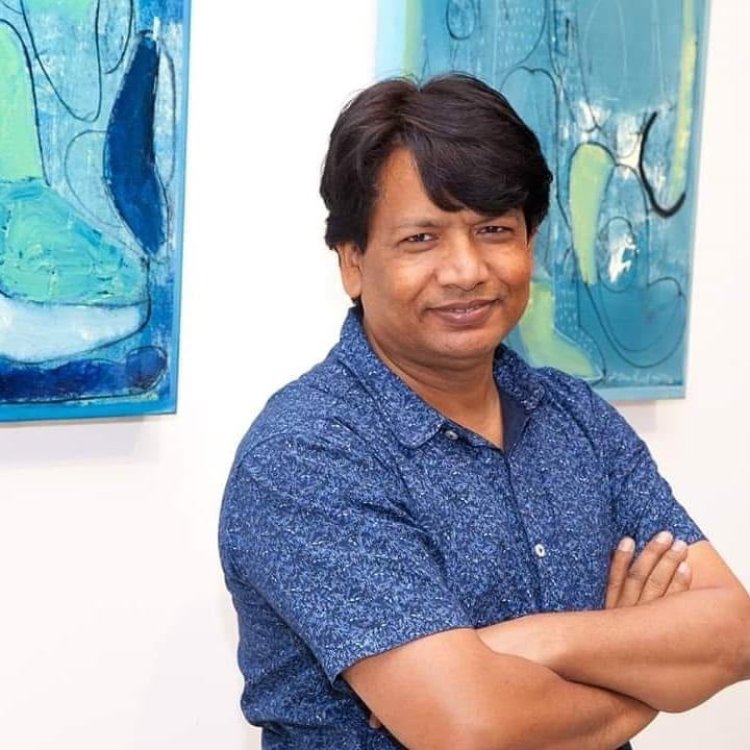
Throughout the history of modern art, painting has been understood as a vehicle of expression. Whether figurative or abstract, artists have sought to communicate emotions, ideas, memories, spirituality or political realities. Even the most radical forms of abstraction have largely remained within the framework of expression.
Indian contemporary artist Hemraj proposes a different direction.
He calls this philosophy Dissolutionism.
Dissolutionism is not a style, nor is it a technique. It is a philosophy of perception.
Its central proposition is simple yet radical:
The highest purpose of painting is not to communicate meaning or emotion, but to dissolve the separation between the viewer and the work of art.
Unlike many traditions of modern abstraction, Hemraj does not regard emotion as the ultimate achievement of painting. Emotions, however profound, remain within the psychological structure of the self. Joy, sorrow, fear and ecstasy continue to reinforce the relationship between the observer and the observed.
Dissolutionism seeks to move beyond this condition.
Hemraj’s paintings contain countless forms, vibrant colours and complex visual relationships. Yet these elements do not function as symbols, metaphors or emotional triggers. They resist narrative and refuse fixed interpretation.
The complexity is intentional.
As the eye moves through innumerable autonomous forms, the habitual search for meaning gradually weakens. Interpretation loses its authority. The analytical mind finds nothing to possess.
At this point, perception begins to change.
The painting is no longer an object standing before the viewer.
It becomes an environment of awareness.
The distinction between the observer and the observed slowly dissolves.
This process gives the philosophy its name.
Dissolution does not signify destruction or disappearance.
It signifies the dissolution of separation.
The painting does not erase the viewer.
It erases the distance between viewer and painting.
Within Dissolutionism, colour exists before emotional symbolism. Form exists before representation. Meaning is no longer imposed upon the image but allowed to remain open until interpretation itself becomes unnecessary.
In this sense, Dissolutionism does not reject the achievements of modern art. Rather, it extends them. If abstraction freed painting from the obligation to imitate reality, Dissolutionism asks whether painting can also free perception from the obligation to interpret reality.
Hemraj’s work therefore proposes a new role for contemporary painting.
Painting is not an object to decode.
It is not a message to consume.
It is a field of consciousness in which perception gradually becomes free from the compulsive search for meaning.
Dissolutionism is not an escape from reality.
It is an invitation to experience reality before it is divided into subject and object, self and other, viewer and image.
In an age dominated by spectacle, information and endless interpretation, Hemraj proposes another possibility.
Not expression.
Not representation.
Not symbolism.
But dissolution.
The painting does not ask to be understood.
It asks to be entered.
And in that encounter, what finally dissolves is not the painting—
but the boundary that once separated the viewer from it.
Prashant singh