Mayaa SH Dismantles the 'Divorced Means Available' Myth In Modern India ..
 The Daily Beat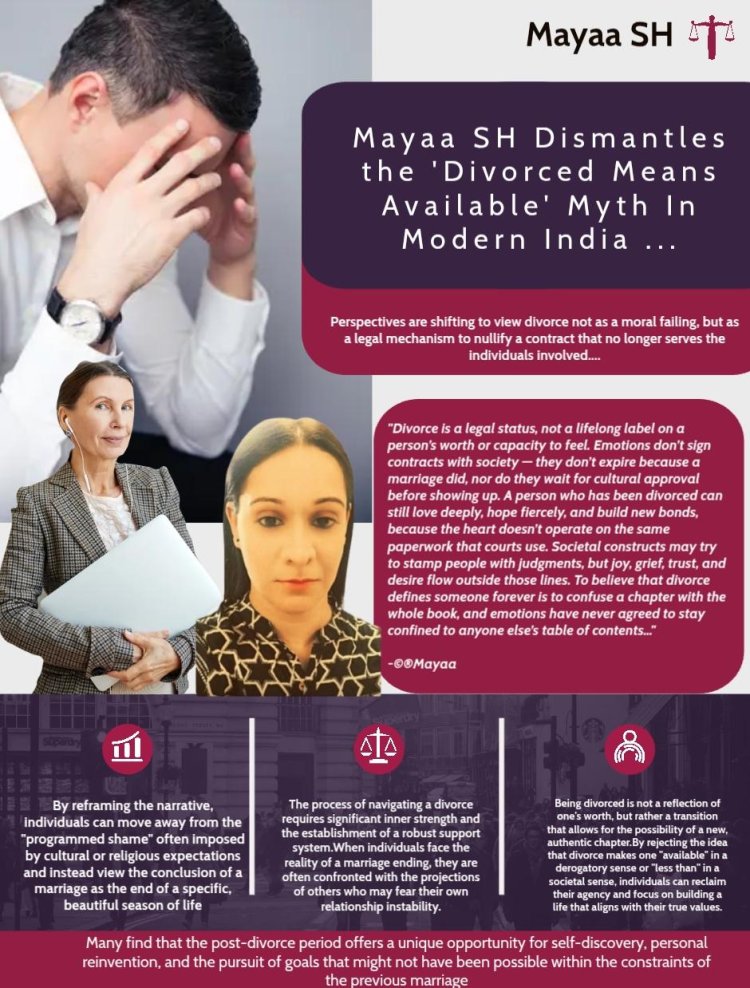
Perspectives are shifting to view divorce not as a moral failing, but as a legal mechanism to nullify a contract that no longer serves the individuals involved.By reframing the narrative, individuals can move away from the "programmed shame" often imposed by cultural or religious expectations and instead view the conclusion of a marriage as the end of a specific, beautiful season of life.
The process of navigating a divorce requires significant inner strength and the establishment of a robust support system.When individuals face the reality of a marriage ending, they are often confronted with the projections of others who may fear their own relationship instability.
Divorce is a court stamp. Not a clearance sale.
That’s the line Mayaa SH is drawing in the sand, and she’s not mincing words. In a culture where a woman’s marital status is still treated as a referendum on her morality, Mayaa SH is calling the bluff: "Ending a marriage does not mean you’ve posted yourself on the market."
That’s the line Mayaa SH is drawing in the sand, and the numbers back her up. India’s divorce rate remains low by global standards — roughly 1 in 100 marriages ends in divorce, with 2026 estimates still close to 1%. Yet the social penalty for ending a marriage hits like it’s 50%.
“Emotions don’t sign contracts with society,” she says. “They don’t expire because a marriage did, and they sure as hell don’t wait for cultural approval to show up.”
The ‘divorced means available’ myth is lazy, entitled, and dangerous. It turns legal paperwork into a leash. It tells women that their consent, privacy, and peace became community property the moment a judge signed off. It shows up in DMs at 1 AM, in job interviews disguised as small talk, in family functions where “so what now?” is code for “who’s next?”
Mayaa SH states, "You can still love deeply, hope fiercely, and build new bonds. But the heart doesn’t operate on the same paperwork that courts use. And it doesn’t report to your assumptions.”
India legalized divorce decades ago. Our mindsets didn’t get the memo. We updated the law, not the gossip. Women still get stamped “divorcee” like it’s a warning label : damaged, desperate, discounted. Men get called “eligible bachelor” by round two. The hypocrisy isn’t subtle. It’s structural.
“Societal constructs try to stamp people with judgments,” Mayaa SH says. “But joy, grief, trust, and desire flow outside those lines. To believe divorce defines someone forever is to confuse a chapter with the whole book.”
Here’s the hard truth:
A woman’s availability is not a default setting triggered by divorce. A woman's marital status is a legal fact. Her consent is a personal one. Conflating the two isn’t just regressive — it’s predatory.
Mayaa SH’s message to the culture:
Stop treating divorce like a dating ad. Stop auditing women’s timelines. Stop assuming a closed marriage is an open door.
“A marriage can end,” she says. “But it never gets to write the whole book of you. And my story doesn’t have a ‘now accepting applications’ page.”
“Emotions don’t sign contracts with society,” Mayaa SH says. “They don’t expire because a marriage did, and they sure as hell don’t wait for cultural approval to show up.”
The Data vs. the Dogma :
India recorded 1.2 million divorce filings in 2024, up 4% year-on-year. Mutual-consent cases drove the increase, and courts have cut the cooling-off period to six months in many cases. But while filings rise, the ‘partner-less’ population — widowed, divorced, or separated — actually shrank from 4.1% in 2014 to 3.5% in 2024. The “divorce crisis” is a myth. The stigma crisis isn’t.
Urban India bears the brunt. Delhi’s divorce rate sits around 7.7%, Maharashtra leads states at 18.7%, and metros like Bengaluru and Delhi report rates exceeding 30%. Kerala alone sees about 75 divorces filed every single day. In Karnataka, 1.95 lakh divorce cases were filed in the last five years.
Yet the assumption persists: Divorced = Available. Mayaa SH calls it what it is — entitled, lazy, and predatory. “You can still love deeply, hope fiercely, and build new bonds. But the heart doesn’t operate on the same paperwork that courts use. And it doesn’t report to your assumptions.”
Who’s filing?
Both Men and Women initiate ∼ divorces in urban settings, driven by rising financial autonomy. Female labor force participation nearly doubled from 23.3% in 2017–18 to 41.7% in 2023–24. Education matters too: women more educated than their husbands are more likely to seek divorce. This isn’t “broken families.” It’s women refusing to stay in broken situations.
The hypocrisy is structural. Urban divorce rates for women hit 0.7% vs 0.5% for men in 2023–24, but only women get the “available” tag. “Societal constructs try to stamp people with judgments,” Mayaa SH says. “But joy, grief, trust, and desire flow outside those lines.”
The cost of the myth:
While courts modernize — 65,971 cases were disposed in 2022 alone — culture lags. The assumption that divorce equals consent shows up in DMs, job interviews, and family WhatsApp groups. It’s why the national W/D/S population is falling, yet social hostility rises. Kerala’s family courts had 112,042 cases pending as of Feb 2025; Maharashtra 66,846. The legal system is processing reality. Society is still processing bias.
Mayaa SH’s demand is simple: Retire the script. “A marriage can end,” she says. “But it never gets to write the whole book of you. And anybody's story doesn’t have a ‘now accepting applications’ page.”
Divorce closes a contract. It doesn’t open a casting call. The stats prove divorce is still rare. The culture proves the stigma isn’t. If your aunt’s WhatsApp group, your coworker’s “harmless” joke, or your uncle’s late-night DM still treats a decree nisi like a dating ad, check yourself. This isn’t tradition — it’s entitlement wearing tradition’s clothes. Availability isn’t decided by a judge, a family, or a society that never had to live the marriage in the first place. It’s decided by the person. Full stop. If that offends your assumptions, good. They needed offending. And if the myth dies screaming, even better.
In words of Mayaa "Divorce is a legal status, not a lifelong label on a person’s worth or capacity to feel. Emotions don’t sign contracts with society — they don’t expire because a marriage did, nor do they wait for cultural approval before showing up. A person who has been divorced can still love deeply, hope fiercely, and build new bonds, because the heart doesn’t operate on the same paperwork that courts use. Societal constructs may try to stamp people with judgments, but joy, grief, trust, and desire flow outside those lines. To believe that divorce defines someone forever is to confuse a chapter with the whole book, and emotions have never agreed to stay confined to anyone else’s table of contents..."
Being divorced is not a reflection of one's worth, but rather a transition that allows for the possibility of a new, authentic chapter.By rejecting the idea that divorce makes one "available" in a derogatory sense or "less than" in a societal sense, individuals can reclaim their agency and focus on building a life that aligns with their true values.Divorce is paperwork, not a verdict on your worth or heart. Emotions don’t need society’s permission to exist or to heal. You can still love, hope, and trust — the heart ignores court dates. A marriage can end, but it never gets to write the whole book of you.