Hemraj: Where Thought Dissolves”
 The Daily Beat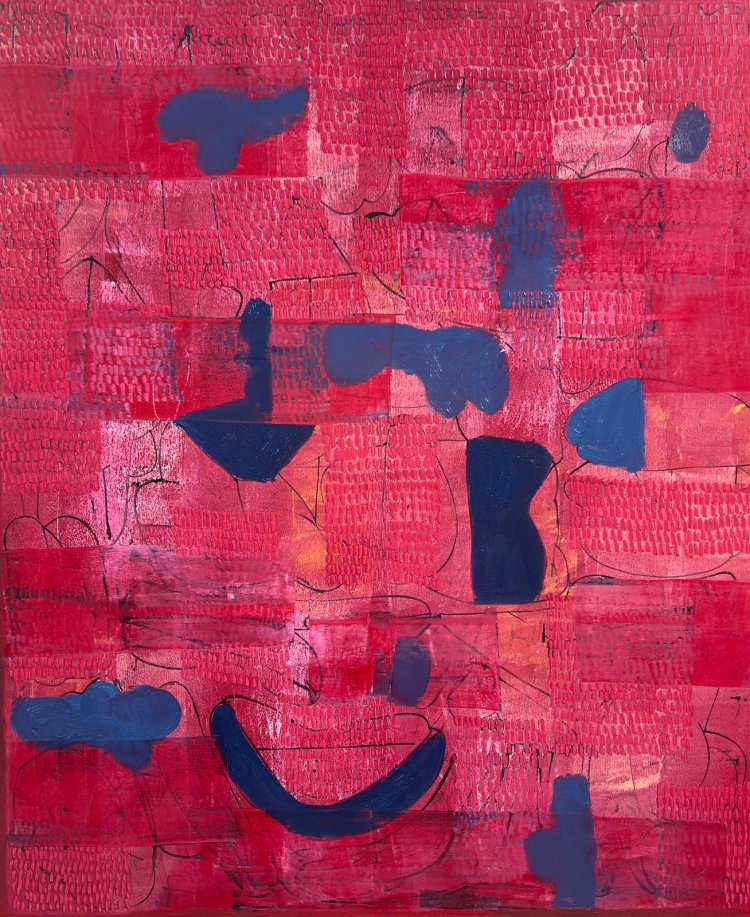
Hemraj’s recent body of work resists the conventional expectation that painting must communicate a fixed idea or concept. Instead, his practice moves in an altogether different direction—one that disengages from the instability of defined meanings and turns inward, towards a more enduring and experiential reality.
For the artist, concepts are inherently transient, shaped and reshaped by time, context, and external interpretation. To anchor a work of art within such shifting frameworks, he suggests, is to limit its potential. Hemraj therefore chooses not to “illustrate” thought, but to create conditions where thought itself can dissolve.
His paintings do not ask to be understood; they ask to be encountered.
Through layered abstraction, intuitive mark-making, and a refusal of predetermined structure, the works open a silent yet profound space—one that gently redirects the viewer away from external narratives and towards an engagement with the self. In this sense, the act of viewing becomes introspective rather than interpretative.
There is no singular message to decode, no conceptual boundary to grasp. Instead, the paintings function as catalysts—inviting the viewer to pause, to look within, and to experience a form of awareness that precedes language and definition.
Hemraj’s work proposes that art need not explain the world; it can instead become a medium through which one reconnects with an inner presence that remains untouched by time, change, or imposed meaning.
In an era where art is often overburdened with conceptual frameworks, his practice stands apart—quietly asserting that the most profound experiences are not those that are explained, but those that are felt.